
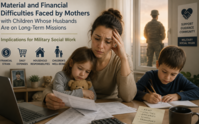



Material and Financial Difficulties Faced by Mothers with Children Whose Husbands Are on Long-Term Deployments
Implications for Military Social Work
ORCID: 0009-0002-0680-0837
Introduction
The family is one of the most important sources of emotional, social, and material support for military personnel. The specialist literature highlights that the family represents an essential factor of individual resilience, contributing to the maintenance of psychological balance and directly influencing the soldier’s resilience and ability to cope with stress-related situations associated with military service (Walsh, 2016). In the case of military personnel, this role becomes even more important, given the characteristics of the profession, such as mobility, exposure to risk, and repeated periods of family separation, which can generate significant changes in family organization and the distribution of responsibilities among family members (Bowen & Martin, 2011).
When a soldier participates in a long-term deployment, the impact is felt not only by the person in the operational theatre, but by the entire family. Research conducted on military families has shown that prolonged separations generate significant changes in the distribution of family responsibilities and in the functioning of the family system, being associated with substantial emotional and social difficulties (Pincus et al., 2001). Spouses of deployed soldiers are often compelled to take on additional responsibilities regarding the upbringing and care of children, household management, and the management of financial resources (Park, 2011).
For mothers caring for one or more children, this period is often marked by complex challenges. They become the primary source of stability for their children and are responsible for managing all aspects of daily life: administering the family budget, paying current expenses, maintaining the household, supervising and educating the children, liaising with schools and medical institutions, as well as managing unforeseen situations that may arise during the husband’s absence. In many cases, these responsibilities are carried out alongside professional activities, leading to a considerable increase in stress levels and physical and emotional demands.
Although a soldier’s participation in overseas missions is generally accompanied by certain financial benefits and specific allowances, these do not entirely eliminate the difficulties faced by the family. In the current economic context, characterized by rising living costs, increased prices for utilities, food and services, as well as intensifying inflationary pressures, the purchasing power of many households has been significantly affected. Orthner & Rose (2009) highlight that mothers left alone to manage the family may encounter difficulties in maintaining a stable financial balance, especially when unexpected expenses arise related to children’s health, education, housing maintenance, or other urgent needs.
The purpose of this article is to analyse the material and financial difficulties faced by mothers with children whose husbands participate in long-term military deployments, and to highlight their implications for the development of military social work services.
To achieve this purpose, the following research questions were formulated:
- What are the main material and financial difficulties faced by mothers with children whose husbands are on long-term deployments?
- What effects do these difficulties have on family dynamics and on the well-being of children?
- What role can military social work play in preventing and mitigating the negative effects associated with these difficulties?
Methodology
The article employs a documentary analysis method and a narrative literature review. In this regard, relevant scientific works from the fields of military psychology, family sociology, family resilience, and military social work published in specialist journals and reference volumes were analysed.
In the selection of sources, priority was given to their relevance to the topic of military families and the impact of the prolonged absence of the deployed spouse on family members remaining at home. Studies on military family adaptation to separation, psychosocial effects, economic vulnerability, and the role of social interventions in supporting military families were included.
The method used aimed to identify the main challenges faced by mothers with children and to formulate recommendations for the development of military social work services.
From the perspective of military social work, knowing and understanding these realities represents an essential condition for developing effective support measures. Specialists in the field have a role in identifying risk factors, assessing the social and economic needs of families, and facilitating their access to available resources. Early intervention can prevent the worsening of difficulties and contribute to maintaining family stability throughout the entire deployment period.
In this context, the analysis of the material and financial difficulties faced by mothers with children whose husbands are on long-term deployments becomes a topic of major interest for military social work. Understanding the challenges they face enables the development of policies and programmes adapted to the real needs of military families, contributing both to improving their quality of life and to supporting the professional efficiency of military personnel in service.
Characteristics of Military Families During Deployments
Military families represent a social category with distinct characteristics, generated by the specific nature of the military profession and the demands associated with it. Unlike most civilian families, military families must periodically adapt to situations involving the temporary separation of family members, frequent relocations, changes in social environment, and the assumption of additional responsibilities. These experiences influence the way of organising family life, the relationships between family members, and the capacity to cope with everyday challenges (Segal & Segal, 2004).
Military activity involves participation in training exercises, tactical applications, specialisation courses, and national or international missions, which may involve variable periods of absence from home. In the case of long-term deployments, the separation between spouses may last several months or even over a year, depending on the nature of the operation and institutional requirements. This absence produces significant changes in the structure and functioning of the family, forcing the members who remain at home to reorganise their roles and responsibilities (Pincus et al., 2001).
For mothers caring for one or more children, this period is often marked by complex challenges. They become the primary source of stability for their children and are responsible for managing all aspects of daily life: managing the family budget, paying current expenses, maintaining the household, supervising and educating the children, liaising with schools and medical institutions, as well as managing unforeseen situations that may arise during the husband’s absence. The specialist literature shows that spouses of deployed soldiers experience increased levels of stress and psychosocial demands, generated by the accumulation of family and professional responsibilities (Lester & Flake, 2013).
In practice, this situation involves assuming a considerable workload. The mother must organise the children’s daily schedule, monitor school activities, attend meetings with teachers, manage any health problems that may arise, and provide emotional support to children affected by the father’s absence. The accumulation of these responsibilities can lead to physical and psychological overload, especially in families with multiple children or young children (Park, 2011).
An important aspect is the fact that separation affects not only the organisation of daily activities, but also the relational balance of the family. Communication between spouses often takes place under limited conditions, influenced by the deployment schedule, time zone differences, or operational restrictions. Consequently, many decisions regarding family life must be made quickly and independently by the partner who has remained at home. This situation can generate feelings of insecurity, excessive responsibility, and isolation.
Military families are also exposed to additional stress factors compared to other family categories. In addition to the usual concerns related to children’s education and the management of financial resources, they face anxiety associated with the safety of the soldier on deployment. Uncertainty about the conditions in which the soldier is carrying out their duties and the lack of permanent contact can amplify the mother’s stress levels and influence the emotional climate of the family.
In many situations, the existence of a support network made up of relatives, friends, neighbours, or other military families represents an essential protective factor. The support provided by these individuals can help reduce the pressure on the mother and more effectively manage everyday problems. However, not all families benefit from such resources. Some live far from their extended family, in garrisons located far from their home town, which limits access to informal assistance.
In the absence of a solid family or community support system, difficulties can intensify. Seemingly simple activities, such as transporting children to school, attending medical consultations, resolving administrative matters, or carrying out repairs to the home, can become additional sources of stress and expenditure. As a result, the time and energy required to manage these situations increases significantly, affecting the quality of life of the entire family.
Regarding material and financial aspects, it is important to emphasise that the difficulties encountered by these families are not generated solely by income levels. Even in situations where the family has relatively stable financial resources, additional costs arise due to the absence of one partner. For example, the mother may need to use paid services for childcare, transport, home maintenance, or other needs that were previously managed within the family.
At the same time, managing financial resources as a single person can become more difficult when unexpected expenses arise. Medical issues, urgent repairs, educational costs, or rising prices for goods and services can affect the household’s financial balance. Without rigorous financial planning or sufficient savings, the family may become vulnerable to temporary economic hardship.
Another characteristic of military families relates to the need to maintain a stable family climate during a prolonged separation. The mother often acts as a mediator between the children who have remained at home and the father on deployment, facilitating communication and contributing to maintaining a sense of family belonging. This emotional effort adds to the daily responsibilities and can influence the level of accumulated stress and fatigue during the deployment period.
From the perspective of military social work, these characteristics highlight the need for specialised interventions adapted to the real needs of families. Regular assessment of the social and economic situation, identification of risk factors, and the development of effective support mechanisms can contribute to reducing vulnerabilities and to strengthening the adaptive capacity of military families on long-term deployments. Supporting these families thus represents not only a social protection measure, but also an investment in maintaining the balance and resilience of a professional category essential to national security.
Main Material Difficulties Faced by Mothers with Children
Increased costs associated with childcare
One of the most frequent challenges is the increase in expenses for the care and education of children. In the father’s absence, the mother may need to use additional supervision services, after-school programmes, tutoring, or help from specialist individuals.
Families with young children are particularly vulnerable, as they require additional resources for ongoing care and supervision, such as the costs of nurseries, kindergartens, or babysitting services.
In certain situations, costs associated with care services can significantly affect the family budget.
Home management and household problems
Mothers left on their own must manage all aspects of home maintenance and household issues. Technical faults, unforeseen repairs, maintenance work, or resolving technical problems generate additional costs and require time, administrative skills, and financial resources. In many situations, tasks that were previously shared between spouses become the exclusive responsibility of the mother, which can lead to overload and unplanned expenditure.
Transport and mobility costs
Transporting children to school, extracurricular activities, or medical appointments entails additional costs for fuel, public transport, or private services. These costs become more pronounced for families living at a distance from schools, medical facilities, or military units.
Limited access to support networks
The absence of a solid family support network can generate additional costs for purchasing services that would normally be provided by relatives or a partner. Activities such as childcare, transportation, or emergency assistance therefore involve extra expenses.
Financial Difficulties and Economic Risks
Individual management of the family budget
The husband’s prolonged absence transfers the entire financial responsibility to a single family member. The mother must manage income, bill payments, loan repayments, educational expenses, and other current financial obligations.
In some situations, a lack of experience in managing certain financial aspects can lead to difficult decisions or the accumulation of debt. The pressure of making important decisions alone can generate anxiety and financial stress.
Orthner and Rose (2009) highlight that individual management of family and economic responsibilities can increase financial vulnerability and the stress levels of military families.
Impact of inflation and rising cost of living
Rising prices for food, energy, services, and children’s products directly affect family budgets. Even when income is stable, purchasing power can decline significantly.
Families with multiple children are particularly vulnerable to economic fluctuations, as a large portion of income is devoted to meeting basic needs.
Long-term financial obligations
Bank instalments, mortgage loans, and other financial commitments represent additional sources of stress. When unexpected expenses arise, the family may face difficulties in maintaining the household’s financial balance and in managing existing obligations.
For some households, the absence of a reserve fund can turn an ordinary event — a medical issue, an urgent repair, or the temporary loss of supplementary income — into a situation of economic vulnerability.
Limitations on mothers’ professional opportunities
The need to take permanent care of children can limit the mother’s ability to work full-time, participate in professional development programmes, accept overtime, or take up positions requiring a high degree of availability. This situation can negatively affect family income and long-term professional development prospects.
Psychosocial Consequences Associated with Financial Difficulties
Material and financial problems do not only have economic effects; they can also influence the psychological health of mothers and children.
Prolonged financial stress can lead to the onset of anxiety, feelings of insecurity, and emotional exhaustion. Mothers in this situation may feel the pressure of multiple responsibilities and the lack of consistent support in managing everyday problems.
Children may manifest various emotional reactions, ranging from sadness and worry to difficulties adapting at school or behavioural problems. In such situations, material difficulties can amplify the emotional impact of family separation.
There is also a risk of social isolation. Some mothers reduce their participation in community activities due to financial constraints or lack of time, which can diminish access to informal support resources.
The Role of Military Social Work
Military social work plays a fundamental role in identifying and supporting families in situations of vulnerability. Specialist interventions must be proactive and adapted to the particularities of each family. Among the main directions of intervention are:
- regular assessment of the social and economic situation of the families of soldiers on deployment;
- informing families about social rights and available facilities;
- counselling for family budget management;
- referral to community and institutional support services;
- facilitating access to psychological services for mothers and children;
- organising support groups for military spouses;
- developing community support networks;
- collaboration with local authorities, non-governmental organisations, and educational institutions.
Early intervention can help prevent the worsening of social and economic problems and contribute to strengthening family resilience.
Recommendations for Improving Support for Military Families
The implementation of the following measures can contribute to increasing family resilience and reducing the risk of social exclusion:
- Development of financial education programmes dedicated to military families;
- Creation of emergency support funds;
- Expansion of social and psychological counselling services;
- Facilitating access to childcare services;
- Organisation of local support networks among military families;
- Regular monitoring of families’ social needs during deployments;
- Strengthening collaboration between military structures and public social assistance services.
Study Limitations
The article presented has certain limitations that must be taken into account when interpreting the conclusions formulated. Although the research is based on the analysis of specialist literature, due to the lack of studies or statistics on military families in Romania, as well as the fact that the field of military social work is not yet formally regulated at national level, it was not possible to include an empirical component in this regard.
Another limitation of the study stems from the fact that the majority of available literature on the impact of military deployments on families originates from North America, particularly from the United States. As such, differences between military systems, social policies, and family support services may limit the generalisation of certain conclusions to the Romanian context.
Finally, the article focuses primarily on the material and financial difficulties faced by mothers with children whose husbands participate in long-term deployments, without analysing in detail the experiences of other categories of military family members. Future research could include empirical studies conducted in Romania, directly investigating the social, economic, and psychological needs of military families, and contributing to the development of specialised military social work services.
Conclusions
Mothers with children whose husbands are on long-term military deployments represent a category exposed to complex material, financial, and psychosocial challenges. The increase in family responsibilities, individual management of economic resources, and the pressure generated by a partner’s absence can significantly affect family well-being and children’s development.
The analysis of specialist literature highlights that economic difficulties should not be viewed solely from the perspective of available financial resources, but from the perspective of their impact on psychological health, family relationships, and the family’s capacity for adaptation. In this context, military social work has the responsibility to identify situations of vulnerability early and to develop interventions adapted to the real needs of families.
Children are also influenced by changes that occur in family life. They feel the absence of the parent on deployment and observe the difficulties the mother faces in managing daily responsibilities. In certain situations, financial constraints can affect participation in educational, recreational, or social activities, with an impact on their development and integration.
Institutional support, combined with community and family resources, can contribute to maintaining the social and emotional balance of mothers and children during deployments. „The military social worker plays an essential role in this process, functioning as a link between institutions, family, and the child, with a view to their identity and social reconstruction” (Oprina, 2026, p.6).
Investment in the well-being of military families represents not only a social protection measure, but also an important contribution to maintaining family resilience, the morale of military personnel, and the operational capacity of the military institution.
References
Distributed as open access under the Creative Commons Attribution 4.0 (CC BY 4.0) licence.