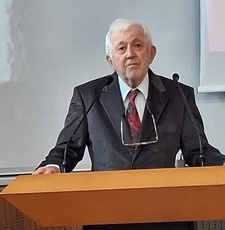
Prof. univ. dr. Viorel Prelici
E-mail: preliciviorel@yahoo.com
Address:Timisoara
About Prof. Univ. Dr. Viorel Prelici
Prof. Univ. Dr. Viorel Prelici is a distinguished academic figure in the development of social work in Romania, being recognised by the West University of Timișoara – Romania as the founder of university-level social work education in the Banat region.
After 1990, he played an essential role in the reconstruction and development of higher education in social work in Timișoara, contributing to the establishment and consolidation of this specialisation within the West University of Timișoara. His academic activity took place during a period of profound transformations in Romanian society, when the reintroduction and development of university-level education in social work represented a necessity for training a new generation of professionals.
His academic career brings together interests in social work, pedagogy, educational psychology, and the study of social phenomena. His works address the theoretical and methodological foundations of social work, education, child protection, juvenile delinquency, and social intervention.
Through his teaching, research, and scholarly publications, Prof. Univ. Dr. Viorel Prelici contributed to the development of the conceptual and methodological framework of university-level social work education in Romania..
An important landmark in his academic activity is the volume Social Work: Idea, Approach, Profession (2001), a work devoted to the foundations and identity of the social work profession in Romania.
He is also one of the initiators of the Military Social Work academic programme in Romania, having proposed the development of this academic field within the Romanian higher education system. His initiative was reflected in the academic debate organised by the West University of Timișoara in March 2024, dedicated to exploring the opportunity of developing Military Social Work in Romania.
Awards and Recognition
In 2026, his contribution to the development of education in the field of social work was recognised through the awarding of the Distinction of Excellence for Outstanding Contribution to the Development of Education in the Field of Social Work, at the National Gala of Excellence in Social Work, organised by the National College of Social Workers of Romania.
Areas of Expertise and Scientific Interest
- Theoretical and methodological foundations of social work;
- Development of university-level social work education;
- Research methodology in social work;
- Child protection and family social work;
- Juvenile delinquency and social rehabilitation;
- Educational psychology and education;
- Personality development and social group dynamics;
- Professional training of social work specialists.
Academic Activity and Institutional Contributions
- Founder of university-level social work education in the Banat region, officially recognised by the West University of Timișoara;
- University Professor at the West University of Timișoara;
- Contributions to the development and consolidation of university social work programmes;
- Academic supervision and scientific coordination of academic research;
- Author and editor of specialised works in the fields of social work and education;
- Contributions to the professional and academic training of social work specialists.
- One of the initiators of the Military Social Work academic programme in Romania, proposing the development of this field within the Romanian higher education system.
Affiliation with RRASM
Through his academic and professional experience, as well as his scholarly interests in social work in general and Military Social Work as a specialised subfield, Prof. Univ. Dr. Viorel Prelici contributes to the development of the academic and international dimension of the Romanian Journal of Military Social Work (RJMSW).
His involvement also supports the advancement of scholarly research, the promotion of academic dialogue, and the strengthening of scientific standards in Military Social Work. His experience and perspective provide valuable support for the journal’s mission to encourage research and international academic cooperation in this emerging field.