


Famous Battles and Their Lessons for Military Social Work: An Interdisciplinary Analysis of Leadership, Resilience and Personnel Support
West University of Timisoara
Faculty of Sociology and Social Work, Romania
ORCID: 0009-0003-8467-5899
E-mail: docasimona@yahoo.com
West University of Timisoara
Faculty of Sociology and Psychology, Romania
ORCID: 0009-0002-0680-0837
E-mail: constantin.oprina@e-uvt.ro
1. Introduction
Armed conflicts have been one of the main factors shaping the evolution of human societies. Although military history is frequently analyzed from the perspective of strategies, weaponry and tactics, contemporary research increasingly focuses on the human dimension of war. The soldier is not merely an executor of orders, but a person continually influenced by psychological, social and cultural factors that determine his or her capacity to cope with operational stress (Bartone, 2006).
In recent decades, military organizations have undergone profound transformations generated by changes in the international security environment. Peacekeeping missions, multinational operations, hybrid warfare and asymmetric threats have led to an expansion of the role of social and psychological support services for military personnel. In this context, military social work has become an essential component of human resource management and personnel protection.
According to the definition adopted in the specialized literature, military social work represents the set of professional activities aimed at preventing and resolving social problems affecting service members, veterans and their families, contributing to the maintenance of operational capacity and to social reintegration after mission participation (Daley, 1999).
Historical experiences demonstrate that numerous armies achieved successes or failures not only due to tactical superiority, but also as a result of how they managed morale, cohesion and personnel welfare. The studies of John Keegan (1976) and Victor Davis Hanson (2001) show that military performance is inseparable from the psychological and social dimension of war.
Currently, NATO doctrine on resilience considers the human factor as one of the fundamental elements of defensive capability. Military training can no longer be limited to tactical instruction, but includes the development of psychological resilience, family support and the consolidation of organizational cohesion.
From this perspective, the analysis of famous battles allows the identification of principles that remain relevant regardless of historical epoch:
- the importance of leadership;
- military group cohesion;
- effective communication;
- organizational adaptability;
- individual and collective resilience;
- logistical and social support;
- personnel protection;
- recovery after losses and trauma.
These elements also constitute the main intervention directions of contemporary military social work.
The aim of this paper is to demonstrate that lessons drawn from major military confrontations can inform the development of modern policies for supporting military personnel and their families. The article seeks to highlight the connection between historical experiences and current practices regarding organizational resilience, prevention of operational stress and human resource management in military institutions.
2. Research Methodology
This paper employs a qualitative method based on documentary and comparative analysis. Six battles considered representative for different historical periods and for the diversity of operational contexts were selected:
- Maraton (490 î.Hr.);
- Cannae (216 î.Hr.);
- Agincourt (1415);
- Waterloo (1815);
- Stalingrad (1942–1943);
- The Normandy landings (1944).
The selection was based on their relevance in military history literature and on the impact they had on the development of strategic thinking. At the same time, each of these confrontations illustrates a distinct dimension of the human factor in war: motivation, leadership, adaptability, cooperation, resilience and the organization of logistical support.
The analysis follows three main directions:
- identification of the human factors that influenced the outcome of each battle;
- assessment of the social and psychological consequences for service members;
- formulation of lessons applicable to contemporary military social work.
Documentation was based on classic works of military history (Clausewitz, Keegan, Liddell Hart, Hanson), on research concerning military psychology and organizational resilience (Bartone, Seligman, Grossman), as well as on NATO publications and studies on military personnel management.
Comparative analysis allows highlighting the continuity of certain fundamental principles that transcend technological differences between epochs. Although weapons and tactics have changed radically, the human factors influencing military performance have remained largely constant. Competent leadership, group cohesion, social support and adaptability continue to represent essential variables for the success of modern military organizations.
Furthermore, the article adopts an interdisciplinary approach, integrating perspectives from military history, sociology, organizational psychology and social work. This approach enables moving beyond purely historical analysis and highlighting the practical relevance of lessons drawn from the past for contemporary systems of military personnel support.
3. Analysis of Famous Battles and Their Relevance for Military Social Work
3.1. The Battle of Marathon (490 BC) — Group Cohesion and Collective Motivation
The Battle of Marathon constitutes one of the earliest historical examples demonstrating the decisive influence of the human factor on the outcome of an armed confrontation. The Athenian army, estimated at approximately 10,000 hoplites, managed to defeat a numerically superior Persian force through discipline, coordination and high morale (Hanson, 2001).
From the perspective of military psychology, victory cannot be explained exclusively by tactics. The Greek hoplites came from the same political and social community, and the defense of the city-state represented a common responsibility. Collective identity and the sense of belonging reinforced individual motivation and reduced the effects of combat stress.
Contemporary literature on military cohesion supports the view that the sense of belonging to a group is one of the most important predictors of operational performance (Siebold, 2007). Service members are motivated not only by strategic objectives, but also by responsibility toward their comrades.
For military social work, the main lesson derived from Marathon lies in the importance of strengthening interpersonal relationships within military units. Counseling activities, organizational integration and team spirit development contribute to reducing psychological vulnerability in high-risk situations.
At the same time, Marathon highlights the role of shared values in maintaining organizational resilience. Modern armies invest in developing organizational culture because it directly influences soldiers’ adaptability during operations.
3.2. The Battle of Cannae (216 BC) — Leadership and Loss Management
Hannibal’s victory over the Roman army is considered one of the most remarkable tactical demonstrations in military history (Liddell Hart, 1991). The double envelopment maneuver used by the Carthaginian commander is still studied today in military academies worldwide.
Beyond the strategic dimension, Cannae offers a relevant perspective on the social consequences of a military disaster. It is estimated that the Roman army lost between 50,000 and 70,000 soldiers in a single day (Goldsworthy, 2001). These losses produced profound effects on local communities, families and the economy of the Roman Republic.
Research on organizational psychology shows that massive losses affect collective morale and trust in military institutions (Shay, 1994). In the absence of efficient support mechanisms, social consequences can persist for generations.
From the perspective of military social work, the experience at Cannae underscores the importance of rapid intervention after traumatic events. In contemporary armies, support provided to the families of fallen service members includes psychological counseling, social assistance, legal support and socio-economic reintegration programs.
Another important lesson concerns leadership. Hannibal continuously adapted his battle formation according to the adversary’s behavior. Currently, the concept of adaptive leadership is considered essential in crisis management, including the coordination of multidisciplinary teams involved in supporting service members.
3.3. The Battle of Agincourt (1415) — Resilience under Conditions of Inferiority
The victory of the English army led by Henry V over the French cavalry demonstrates that military performance depends to a considerable extent on the capacity to adapt to environmental conditions and on the quality of leadership.
English soldiers were in a precarious physical state. Many troops suffered from illness, exhaustion and malnutrition after the campaign conducted in France. Nevertheless, discipline and confidence in their leader allowed the maintenance of combat capability.
From the perspective of organizational resilience, Agincourt illustrates the capacity of an organization to function effectively under extreme conditions. Bartone (2006) defines military resilience as the ability to maintain performance despite intense stress and uncertainty.
Currently, resilience development constitutes one of the priorities of NATO programs on military personnel training. Interventions include psychological training, development of emotional competencies and consolidation of relationships between service members and leaders.
Military social work contributes to this process by identifying risk factors, supporting soldiers in difficulty and developing preventive programs oriented toward mental health.
3.4. The Battle of Waterloo (1815) — Inter-institutional Cooperation and Communication
Waterloo represents a classic example of the importance of cooperation between allied forces. Victory against Napoleon was not the exclusive result of a single army’s performance, but of effective coordination between the British and Prussian armies.
From the perspective of organizational management, this confrontation demonstrates the role of communication and mutual trust between different structures.
Currently, NATO operations presuppose permanent collaboration among service members belonging to states with distinct cultural and organizational systems. Their integration requires efficient mechanisms of communication, psychological support and intercultural adaptation.
Military social workers frequently participate in programs dedicated to the families of service members deployed in multinational missions, facilitating their adaptation to changes generated by mobility and temporary separation.
The experience at Waterloo demonstrates that the success of a modern military organization depends not only on individual performance, but also on the quality of relationships between the institutions involved.
3.5. The Battle of Stalingrad (1942–1943) — Psychological Trauma and the Limits of Human Endurance
The Battle of Stalingrad is considered one of the most devastating confrontations in human history. The number of military and civilian victims exceeded two million, and climatic and logistical conditions amplified the suffering of combatants.
Numerous studies on post-traumatic stress utilize the experiences of World War II veterans to explain the effects of prolonged exposure to violence (Shay, 1994).
Service members involved in urban combat were permanently exposed to bombardments, hunger and the loss of comrades. These experiences generated psychological disorders which, at the time, were insufficiently understood and rarely treated.
After the war, the development of military psychology and social services for veterans was directly influenced by the traumatic experiences of this generation.
Currently, military social work pays special attention to the prevention of post-traumatic stress disorder (PTSD), family counseling and social reintegration of service members returning from theaters of operation.
The experience at Stalingrad demonstrates that operational performance cannot be separated from the protection of mental health.
3.6. The Normandy Landings (1944) — Integrated Planning and Personnel Protection
Operation Overlord represents one of the most complex examples of integrating strategic planning with human resource management.
The success of the landings was made possible by unprecedented logistical preparation. Mobile medical systems, evacuation of the wounded, continuous supply and moral support services were organized for hundreds of thousands of service members.
This model demonstrates that operational efficiency depends on the existence of structures capable of protecting human resources.
In contemporary literature, the concept of force health protection includes all measures aimed at maintaining the physical, psychological and social health of military personnel.
Military social work contributes to this objective through:
- assessing the social needs of service members;
- supporting families during missions;
- crisis counseling;
- facilitating reintegration after return from theater;
- coordinating multidisciplinary interventions.
Normandy demonstrates that personnel protection does not represent a secondary activity, but a strategic component of military success.
4. Comparative Analysis
Although more than two millennia separate Marathon from Normandy, comparative analysis highlights the existence of certain constants of military performance:
- competent leadership;
- social cohesion;
- effective communication;
- high morale;
- adaptability;
- logistical and social support;
- protection of physical and mental health;
- capacity for recovery after losses.
These elements are today integrated into modern military doctrine and constitute the basis of the activity of specialists in military social work. The evolution of armed conflicts has demonstrated that investment in the human factor produces long-term effects both on operational efficiency and on the sustainability of military organizations.
5. Discussions
The comparative analysis of the battles of Marathon, Cannae, Agincourt, Waterloo, Stalingrad and the Normandy landings highlights the fact that military performance cannot be explained exclusively by numerical, technological or tactical superiority. Human factors—leadership, morale, group cohesion, resilience and organizational support—decisively influence the capacity of a military structure to fulfill its mission. This conclusion is supported both by classical military history literature (Clausewitz, 1976; Keegan, 1976) and by recent research in organizational psychology and military sociology (Bartone, 2006; Seligman, 2011).
From the perspective of military social work, each of the analyzed case studies highlights a distinct dimension of support provided to personnel. Marathon demonstrates the importance of collective identity and the sense of belonging, Cannae underlines the necessity of managing the social consequences of human losses, Agincourt highlights the role of organizational resilience, Waterloo confirms the value of inter-institutional cooperation, while Stalingrad and Normandy show that the physical and mental health of service members are essential conditions for operational efficiency.
These conclusions are consistent with NATO doctrine on resilience, which defines an organization’s capacity to resist, adapt and continue mission fulfillment under operational stress conditions. Within this model, military social work contributes to maintaining individual and organizational resilience through preventive interventions, counseling services and programs dedicated to military families.
Furthermore, specialized literature emphasizes that family support represents one of the most important protective factors against operational stress. Service members who benefit from stable family relationships and efficient social assistance services exhibit lower levels of anxiety and greater capacity to adapt to professional demands (Bowen & Martin, 2011).
At the same time, historical analysis demonstrates that the effects of armed conflicts extend beyond the period of their conduct. Psychological traumas, reintegration difficulties and social problems can persist long after hostilities have ended. Consequently, military social work services must adopt a continuous approach, including prevention, intervention during missions and post-mission support.
6. Implications for the Romanian System of Military Social Work
The historical experiences analyzed offer relevant directions for the development of military social work services in Romania.
First, it is necessary to strengthen programs for preventing operational stress. Recent research demonstrates that preventive interventions reduce the incidence of psychological disorders and facilitate soldiers adaptation to the demands of international missions.
Second, services dedicated to military families must be expanded and integrated into human resource management. The family represents the primary informal support system, and its functioning directly influences the service member’s professional performance.
Another important direction concerns the development of reintegration programs for personnel returning from theaters of operation. These programs must include psychosocial assessments, individual and family counseling, as well as activities aimed at professional and community reintegration.
Furthermore, interdisciplinary collaboration among social workers, psychologists, military physicians and commanders must be strengthened. The complexity of social problems generated by modern conflicts requires integrated interventions, centered on the person and the family.
In the current context of Romania’s NATO membership and participation in international missions, the permanent adaptation of social support services represents an essential condition for maintaining the operational capacity of the armed forces.
6.1. Integration of NATO and Ministry of National Defense Doctrinal Documents on Resilience and Personnel Support
Transformations in the security environment over the past two decades have led NATO to place increasing importance on the human factor and on the capacity of military organizations to resist and adapt in the face of complex threats. Within the NATO Summit in Warsaw (2016), resilience was defined as a national and collective responsibility, being considered an essential component of collective defense. Subsequently, NATO’s Strategic Concept of 2022 reaffirmed that the resilience of societies and military institutions represents a multiplier of defensive power.
From a doctrinal perspective, military resilience exceeds the technological and logistical dimension, including the physical and mental health of personnel, continuity of support services, protection of military families and the capacity of organizations to maintain functionality under crisis conditions. These elements are found in NATO doctrines on joint operations and human resource management, which promote an integrated approach to personnel protection (force protection and force health protection).
In Romania, the Ministry of National Defense has adapted these principles through the development of policies dedicated to human resource management, occupational health and psychological support provided to service members participating in external missions. Doctrinal documents on personnel training emphasize the necessity of psychological assessment before, during and after missions, as well as collaboration among commanders, psychologists, physicians and social workers for preventing the effects of operational stress.
The role of military social work is defined in a manner complementary to psychological and medical activity. The military social worker contributes to identifying family vulnerabilities, counseling service members and their relatives, facilitating access to social services and supporting professional and community reintegration after participation in operations.
From this perspective, the lessons drawn from major historical battles are compatible with current doctrinal principles of NATO and the Ministry of National Defense. Both historical experiences and contemporary documents confirm that military success depends on the existence of efficient structures for protecting human resources.
6.2. Romanian Context — Lessons from the Romanian Army’s Participation in International Missions
Romania’s participation in international operations conducted under NATO, the UN and the European Union has contributed significantly to the development of the national system of military social work. Missions in Afghanistan, Iraq and the Western Balkans have demonstrated that contemporary challenges differ substantially from those specific to conventional conflicts, yet the human factor remains decisive for operational success.
In the theater of operations in Afghanistan (2002–2021), Romanian service members were exposed to multiple risks, including improvised explosive device (IED) attacks, ambushes, long-duration missions and prolonged operational stress. These conditions highlighted the importance of psychological preparation before deployment and of reintegration programs after return to the country.
The experience accumulated in Iraq underscored the necessity of interdisciplinary cooperation among medical, psychological and social structures. Service members returning from missions benefited from medical and psychological assessments, and in situations involving family or social difficulties, specialists from the field of social work were involved.
Operations conducted in the Western Balkans demonstrated another dimension of military resilience: intercultural adaptation. Romanian service members collaborated with personnel from numerous NATO member and partner states, which required the development of intercultural communication competencies and the consolidation of cooperation capacity in a multinational environment.
In all these missions, support provided to military families represented an essential component of human resource management. Extended periods of separation, changes generated by mobility and reintegration difficulties after return from theater highlighted the necessity of social services adapted to the needs of service members and their families.
The operational experience of the Romanian Army confirms the conclusions drawn from the analysis of historical battles: organizational resilience is the result of the interaction between leadership, professional training, group cohesion and the existence of efficient mechanisms of social support.
Table 1. Synthesis of Analyzed Historical Battles, Dominant Human Factors and Implications for Military Social Work
| Battle | Main Lesson | Dominant Human Factor | Implications for Military Social Work |
|---|---|---|---|
|
Maraton (490 î.Hr.) | Victory can be achieved through cohesion and motivation, even under numerical inferiority. | Group cohesion and collective identity | Strengthening team spirit, integration of new service members, development of organizational culture. |
|
Cannae (216 î.Hr.) | Leadership and adaptability decisively influence operational outcomes. | Adaptive leadership and crisis management | Post-critical event interventions, support for families of fallen service members, loss management. |
|
Agincourt (1415) | Resilience can compensate for the lack of material resources. | Individual and organizational resilience | Resilience development programs, prevention of professional burnout, psychosocial counseling. |
|
Waterloo (1815) | Cooperation and inter-institutional communication are decisive. | Trust and collaboration | Cooperation among social workers, psychologists, physicians and commanders; support in multinational missions. |
|
Stalingrad (1942–1943) | Prolonged exposure to conflict produces long-lasting psychological effects. | Trauma and operational stress | Psychological screening, PTSD prevention, reintegration programs and support for veterans. |
|
Normandia (1944) | Personnel protection is an integral part of operational success. | Organization of logistical and medical support | Integration of medical, psychological and social services; protection of families and human resource management. |
Figure 1. Conceptual Model of the Relationship between Leadership, Resilience and Military Social Work
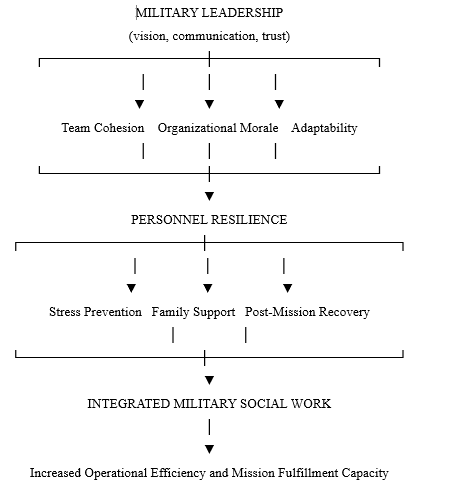
Legend: Conceptual model developed by the author based on literature on military leadership, organizational resilience and military social work.
Figure 2. Evolution of Support Provided to Service Members throughout the Operational Cycle

Figure 2 highlights the fact that military social work intervention must be continuous and integrated, not limited to the mission period.
Figure 3. Historical Lessons and Their Applicability in Military Social Work


Conclusions
The analysis of history’s major battles demonstrates that military success is determined to a significant extent by the human factor. Effective leadership, group cohesion, high morale, resilience and the existence of appropriate social support mechanisms decisively influence the outcome of military operations.
From the perspective of military social work, the lessons drawn from historical confrontations are particularly relevant. They confirm that the protection of military personnel must be approached in an integrated manner, including social, psychological and family dimensions.
Furthermore, historical experiences highlight that the effects of war continue long after confrontations have ended. For this reason, interventions by specialists in military social work must not be limited to conflict periods, but must be extended over the service member’s entire professional trajectory and over the process of social reintegration.
In a security environment characterized by complex threats and multinational operations, investment in the human factor represents one of the most effective ways of consolidating organizational resilience. The lessons drawn from Marathon, Cannae, Agincourt, Waterloo, Stalingrad and Normandy demonstrate that, regardless of military technology evolution, the human being remains the central element of any military organization.
In conclusion, historical analysis confirms that the development of modern military social work services does not represent merely a component of social protection, but also a strategic factor contributing to increased operational efficiency and to maintaining the state’s defensive capacity.
REFERENCES
Article published under license Creative Commons Attribution 4.0 International (CC BY 4.0).